
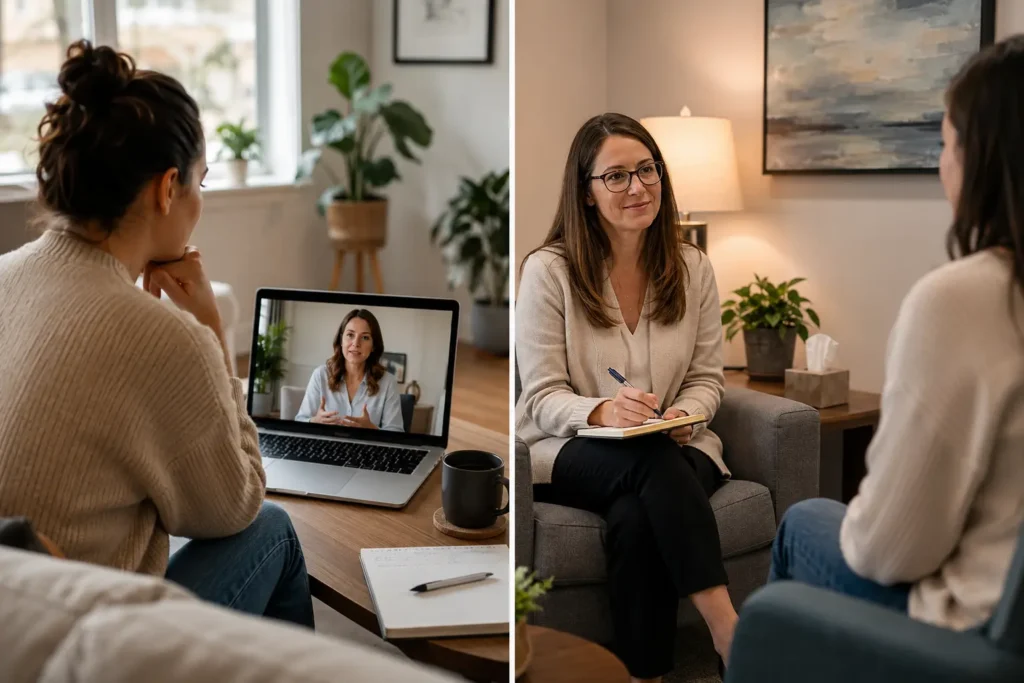
If you live in Westchester County, chances are your calendar is already packed. Between the commute into the city, school drop-offs, work deadlines, and everything else that fills up a day, finding time to take care of your mental health can feel like one more thing on a list that’s already too long. That’s probably why so many people here end up asking the same question before they ever pick up the phone to book a session: should I see a therapist in person, or would online therapy actually work just as well?
There’s no single right answer. Both formats can lead to real, lasting progress. But they fit different lives, different personalities, and different kinds of struggles. Here’s a closer look at how the two compare, so you can figure out which one actually makes sense for where you are right now.
Online therapy isn’t a watered-down version of “real” therapy. It’s the same licensed clinician, the same clinical training, and often the same therapeutic approaches — CBT, DBT, trauma-informed care — just delivered through a secure video platform instead of a couch in an office. Sessions are typically 45 to 50 minutes, scheduled the same way an in-person appointment would be, and just as confidential.
For a lot of Westchester residents, this format solves a very specific problem: time. If your job already has you driving into Manhattan four or five days a week, adding a 30-minute drive each way to a therapist’s office isn’t just inconvenient, it’s often the reason people put off getting help in the first place. Online therapy removes that barrier. You can have a session during a lunch break, right after the kids are dropped off, or from your bedroom at 7pm without ever getting in the car.
There’s also a comfort factor that people don’t always expect going in. Some clients find it easier to open up about painful or private topics — a strained marriage, childhood trauma, anxiety that’s been building for years — from a space that feels entirely their own. No waiting room, no chance of running into someone you know, no drive home while you’re still processing what came up in session.
When you are not limited to therapists near your home, you can choose someone who truly understands your needs. This matters a lot if you are looking for a specific approach, like trauma-informed care, or a therapist who speaks your language.
Some people worry about being seen walking into a therapist’s office. Online therapy removes that worry completely. No waiting rooms, no running into a neighbor.
Yes. Research over the past several years has shown that online therapy can be just as effective as in-person therapy for many common concerns, including anxiety, depression, stress, and trauma. What matters most is not whether you are in the same room as your therapist, but whether you feel safe, understood, and supported during your sessions.
A good therapist will build the same kind of trust and connection online as they would in person. The screen does not have to be a barrier. For many Westchester residents, it actually becomes the reason they finally start therapy, because it removes the excuse of “I don’t have time.”
That said, in-person therapy has real advantages too, and it would be dishonest to pretend otherwise.
Sitting across from another human being changes the dynamic of a conversation. Therapists who work in person can pick up on body language, tone, and subtle physical cues that don’t always translate through a screen — a clenched jaw, shifting in a seat, a pause that says more than words do. For clients working through significant trauma, PTSD, or deeply rooted relational patterns, that in-the-room presence can add a layer of connection that some people need in order to feel safe enough to do the harder work.
There’s also the simple matter of separation. Going somewhere for therapy creates a physical boundary between “regular life” and “therapy time.” For some people, that boundary matters. It signals to the brain that this hour is different, protected, set apart from the rest of the day. Doing therapy from the same couch where you also answer emails and watch TV can blur that line for some clients, even if it doesn’t for others.
And for anyone without reliable privacy at home — a small apartment, roommates, a partner who’s often around — an office might genuinely be the only place a session can happen without interruption or the fear of being overheard.
Rather than thinking about this as “which is objectively better,” it helps to ask a few honest questions about your own life.
If getting to an office twice a month during business hours is already a stretch, that’s worth taking seriously. Therapy only works if you can actually show up for it consistently. A slightly less “ideal” format that you’ll stick with beats a perfect format you’ll cancel on three weeks in.
Online therapy depends on being able to talk freely without worrying about who’s in earshot. If your home doesn’t offer that right now, in-person sessions might be the more realistic option, at least for a while.
Day-to-day stress, anxiety, work-life balance struggles, and general emotional overwhelm tend to respond very well to online formats. Complex trauma, severe PTSD symptoms, or situations involving safety concerns sometimes benefit from the added structure and physical presence of in-person care, especially early on.
Some people think out loud best while sitting with someone in a room. Others find they’re more honest and less guarded when there’s a small buffer, like a screen, between them and the person they’re talking to. Neither is wrong. It’s worth being honest with yourself about which one actually describes you.
One thing that comes up constantly with clients across Westchester County is how much the commute itself contributes to stress in the first place. Long drives or train rides into the city, unpredictable traffic, back-to-back meetings that leave no real breathing room during the day — by the time evening rolls around, a lot of people are simply depleted. Asking someone in that position to then drive another 20 or 30 minutes to a therapist’s office can end up being the very thing that keeps them from booking the appointment at all.
This is part of why online therapy has become such a practical fit for so many Westchester professionals and families. It’s not about cutting corners on care. It’s about removing one more obstacle from a day that already has plenty of them, so that the actual work of therapy — the part that matters — can happen consistently, week after week, without logistics getting in the way.
If you are new to therapy, the idea of picking the right therapist can feel overwhelming. You may be wondering where to even begin, especially with so many options online and in your local area. We put together a full guide to help make this easier. You can read How to Find the Right Psychotherapist in Westchester County for simple, step-by-step advice on choosing a therapist who fits your needs.
It’s also worth knowing that this isn’t necessarily a permanent decision. Plenty of people start with online sessions because it’s the only realistic option given their schedule, and later shift toward occasional in-person visits once things settle. Others do the opposite, starting in an office and eventually moving online once they’ve built a strong working relationship with their therapist and no longer feel like they need the physical setting to feel safe.
What matters most isn’t which format you pick on day one. It’s finding a rhythm you can actually maintain, with a therapist you trust, addressing what you’re actually going through. Consistency is what makes therapy work, far more than the medium it happens through.
If you’re in Westchester County and trying to decide what makes sense for you, westchester psychotherapy consultations are a low-pressure way to talk it through before committing to either format. Sometimes the clearest way to know what fits is simply to ask the questions out loud with someone who can help you think it through.